Blog post
Observing Tsang Wing Fai choreographic process for this year’s theme Out of Place brings to the fore not only how the theme is interpreted by the choreographer, but how, as entangled and non-linear as any choreographic process, the practice becomes a chain of encounters between humans and non-human actants through which choreographic material, motifs, and pathways emerge. This post examines the nature of those relationships as they unfold in the creative process, to highlight how human and non-human agents (spaces, materials, forces, etc.) have “efficacy in the co-construction of practices, events and figurations” (Choat, 2020). In what follows I trace this through several encounters: with remembered and drawn clouds, with cotton as a tactile stand-in, and with the site of Russell Square itself.
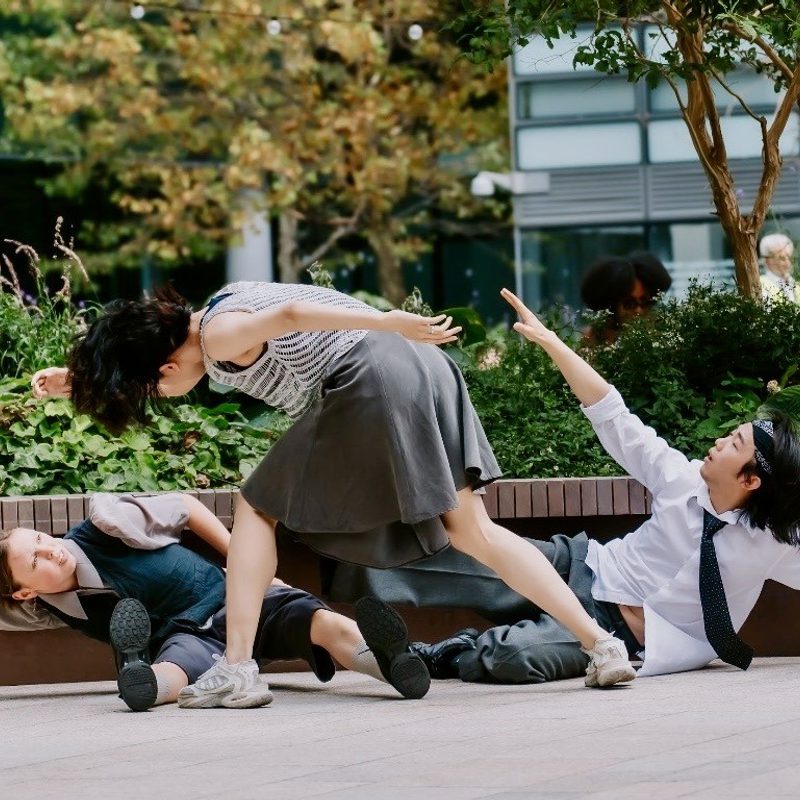
Fai’s exploration of Out of Place began broadly, with questions of language, culture, and contrast, but after cycling through several conceptual interpretations she returned to the site itself, and it was the site that resolved the theme. Reading Russell Square with an architect’s eye (a training she brings into her choreographic practice), she attended to its inherent structures: its pathways, its verticals, the planes formed by trees and poles, the layered horizontals of canopy, empty air, and grass. As she put it in interview: “I will choose a [set] of the structures with planes […] horizontal, vertical. What if it is something like — not in this dimension, but here? […] What if I choreograph something around there [looks at the sky] and then put the idea in here [signals the ground]?” (Fai, interview with the author, July 7, 2026). Out of that architectural reading came the decisive move: to bring the sky, and the clouds, down to the ground. The clouds, displaced from their proper dimension into Russell Square, are the piece’s answer to Out of place. The site, in other words, became the interlocutor that produced the concept. Because clouds, as Fai notes, are known “only by observation,” the choreographer opened the process by asking the dancers to summon their memories and understanding of clouds in their places of origin, the clouds of London, Taiwan, Beijing, and Hong Kong, through writing, drawing on paper, and shared conversations. A second conversation followed, this time with material. Because clouds cannot be touched, the choreographer introduced stuffing cotton as a tactile stand-in. The dancers tore it, held it, and let it fall; from that encounter a movement motif, the “bounce,” the “movement quality”, was drawn. The cotton is a non-human performer in the rehearsal room, and the motif was not authored onto the dancers but produced by their articulation of the material’s behaviour in their hands. Sensation preceded vocabulary; matter proposed and the body articulated. The cotton encounter is followed by others, as the dancers meet the park’s actants improvisationally, one by one, the bench, the poles, the trees. Each thing solicits a different response: a pole invites suspension; a bench, levels and shifts of weight; a tree, orbit and pressure. The relation runs both ways: as the dancers respond to what a pole affords, the pole becomes, for the duration of the piece, something other than a pole. These are agents whose material specificity shapes what movement can be made with them. Motifs and pathways through the site are the sediment of these conversations and encounters, a co-construction of the choreographic work by humans and non-humans alike.
A final conversation opens overhead. The canopy of trees under which the piece unfolds is not scenery but structure: its low ceiling, its dappled and shifting light, its shaded interior set against the exposed grass, its arrangement of trunks and gaps — all offer the choreographer and the dancers another point of inter-action. In conversation with the concept of cloudness, the canopy reveals itself as a kind of cloud already in place: overhead, uneven, mobile with the wind, dividing an above from a below. The dancers’ improvised passages beneath it are shaped as much by what the canopy affords, its filtered light, its columns, its low sky, as by any instruction. Cloudness, brought down to the ground, meets the ground’s own cloud waiting there. What this process makes visible is not a list of collaborators, cotton, pole, bench, tree, canopy, pathway, but a way of working in which agency does not sit with any one of them. Following Barad, “agency is a matter of intra-acting; it is an enactment, not something that someone or something has” (Barad, 2003, p.827). Kramer extends this precisely to the ground Out of Place stands on: “agency is thus positioned as coming into effect through confederations between the human and nonhuman, and […] dancing among the nonhuman offers an effective space to taste and practice such considerations” (Kramer,2012, p.85). Fai’s process is one such space. It is a practice of co-attention to the world, an attunement to what pathways, materials, canopies, and remembered skies are already doing — and it is out of that attentiveness, that the work comes.
by Maria Salgado Llopis (Scholar)


Posted by