Blog post
To call the ArtsCross website out of place is not to say the creative process has been misplaced or lost. It is to name an ontological condition. Two modes of being are at play: the creative process and performance as an embodied, present-tense experience unfolding over three weeks, and the website as an archive persistent, textual, retrievable, held together by hyperlinks rather than by bodies. The website is not a version of the process; the two belong to different orders of being. This provocation begins after the studio and the park have emptied. Its territory is what remains, and its particular case is the presence of FUBUNATION. What out of place describes is the passage between these two realms: how a doing, having ended, continues to exist as remains under conditions its original mode of being did not set.
Diana Taylor’s distinction between archive and repertoire offers the cleanest way to name this passage. The repertoire holds “embodied memory conveyed in gestures, the spoken word, movement” (Taylor, 2003). FUBUNATION’s studio process was repertoire: breath, weight, the involuntariness of a decision arriving in a spine, the dwelling on a gesture, the improvised interpretation of a movement. On the website, that repertoire has become archive: video material and scholarly entries, the remains of a practice that once took place. Yet these remains do not merely represent the event. For those who meet the work only through the website, they constitute it (Auslander, 2015).
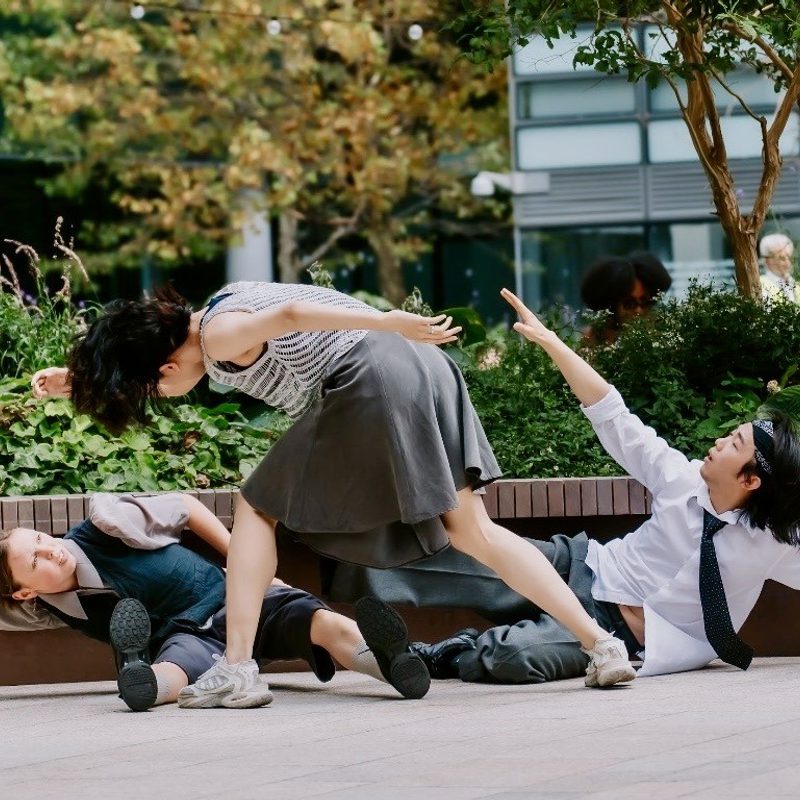
The archive performs a means of access, and in doing so it turns remains into the primary reality. On the ArtsCross site, FUBUNATION’s presence is to date small yet significant: a brief rehearsal video from day two, a few seconds within a weekly recapitulation, and two entries by scholars. Neither entry is the whole; each is what the process has become through the attention of the scholar or filmmaker who captured, edited and uploaded it. Tom Hastings records the interior of a somatic studio session, holding onto Waddah's words to the dancers “just move to feel, not to perform… feel the involuntariness of it” (Hastings, 2026). Wu Yi-Jung observes a rehearsal of three duets at Regents Place Plaza, catching the choreographers' subtle corrections “Slower, Lighter, Breathe together” and offering a reading of the work as portraying “the vulnerability and resilience of contemporary urban individuals” (Wu, 2026). For a future viewer who was not in those spaces, these fragments are not partial records; they are what can be read and understood of FUBUNATION’s process, and of the meanings that emerge from its remains. Both entries have become instruments, and what they instrument is future encounter.
It is here that André Lepecki's reframing of the dance archive becomes generative. For Lepecki, “the end of a performance is the new beginning of a dance’s afterlife, which permits the work to undergo numerous permutations and manifestations” (Lepecki, 2010). The archive, in this account, is not the end of the dance but "the vertiginous skin where all sorts of onto-political ‘rewritings’ take place, including the re-writing of movement, including the re-writing of the archive itself" (Lepecki, 2010). Read through Lepecki, the ArtsCross site is one of FUBUNATION's afterlives, and its remains are not backward-looking traces. Waddah's “just move to feel, not to perform” is available now to any dancer who reads it and may enter a practice on terms the studio session could not have set.
The choreographers’ “breathe together” might travel into scholarly writing, into teaching, into future workings-with. The remains can become instruments of future practice, and that capacity is a property of the mode of being they now inhabit. What out of place names, then, for the creative process at ArtsCross London 2026, is the ontological condition under which a doing continues to exist by becoming something else. Persistent where it was temporary, retrievable where it was present, textual where it was embodied and can, from that new mode of being, do work in the world. The site is where the making now happens for those who come after: not because the making is repeated there, but because the remains are the form the making has taken.
These ideas open questions that this provocation wants to hold open rather than close. How do creative processes now circulate on the site? And what kind of history is being written by an archive whose evidence is somatic instruction and scholarly attention? The question it ends on is more immediate, and it is addressed to those of us still writing. The site is not finished. Its remains are still being made, by hands that are ours including, this afternoon, by the discussions held in this symposium.
As we continue to write and to populate the ArtsCross website as scholars still with access to the dancers, still catching what we catch: What afterlives will these new entries create? Which embodied experiences of the room are made into remains, and how? Knowing what we know today, how are we acting now so that, when we look back on this process, we can say what it was?
Postscript: This entry, once uploaded, is no longer only a reading of the ArtsCross archive; it is part of it. Written after the studio emptied, it has itself become one of the remains it describes: a fragment through which some future reader, who was not in the room, will meet FUBUNATION at ArtsCross London 2026. It does not stand outside the archive to judge it; it is folded into the same generative work. And so, it invites the next scholar-observer to read it, and to write past it, as one more of the process’s afterlives.
Written by Maria Salgado Llopis (Scholar)
Posted by