Blog post
Group 7 Cheng Yongping
3 July Friday afternoon
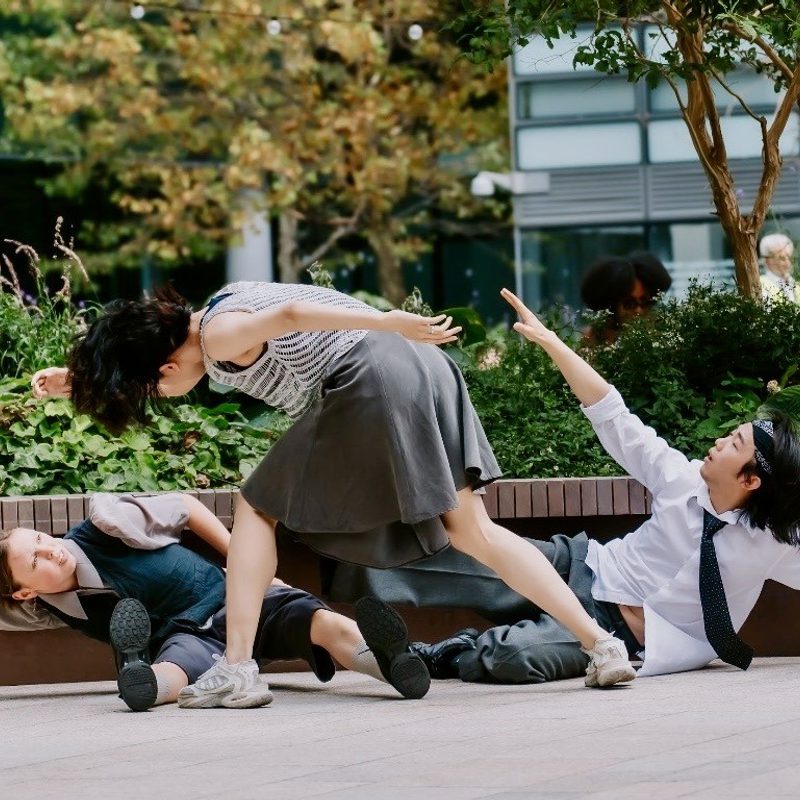
下午的阳光,树影婆娑。今天下午参加排练的演员并不整齐,编导决定用一些时间和舞者们一起讨论作品中的一个场景设置。这个场景中,一个舞者侧躺在地上,似乎是因为炎热的天气(在采访中,永萍说“伦敦太热了”是此次作品的主题),为了帮助同伴,另外一位舞者需要使用一个用来喷水的瓶子。据编导说,这个瓶子是她在超市买的,并且买了一个启瓶器,用来在水瓶盖上钻了数个大小不一的孔。通过挤压瓶子,水会滋出来,像是浇灌植物一样,浇灌被“热”击倒的舞者。
永萍忽然觉得应该让“照护”同伴的舞者用嘴巴来喷水。她做了一个示范动作,将水含在口中,通过口腔的压力,喷出雾状的迷你水幕。当香港舞者尝试同样的动作时,有趣的时刻发生了:她无法喷出足够细密的水雾,水滴从她的嘴里流淌出来,不能达到足够的“射程”距离。这是我第一次意识到,原来一个喷水的动作,也并不如想象中一样可以“共享”。身体运动的的每一个瞬间(在这个时刻是口腔)都会调用我们平时无法意识到的肌肉力量和协同性的生理网络(例如呼吸配合、肺活量等等),所以即便是平常如“用嘴喷水”的动作,也完全不似我们想象中那样可以通约。
我经常认为舞蹈相比于语言,更容易跨越个体的文化边界,但是几乎没有意识到原来身体也有自己的“边界”:不是一种经过训练后的舞者身体,而是任何一个作为协同网络的身体系统。一口含在嘴里难以喷出的水,它提出了一个问题:也许我们过于高估了身体的通约性?也许,像语言一样,身体也有自己的“巴别塔”。
The afternoon sunlight filtered through the trees. Not all of the dancers were present for rehearsal, so Yongping decided to spend some time discussing one particular scene with the group.
In this scene, one dancer lies on the ground, seemingly overcome by the extreme heat. (In her interview, Yongping mentioned that “London is too hot” had become one of the inspirations for the work.) Another dancer tries to care for them using a plastic water bottle. Yongping explained that she had bought the bottle in a supermarket and pierced several small holes in the bottle cap with a bottle opener. When squeezed, the bottle releases a gentle spray, watering the exhausted dancer like a small watering can.
Then Yongping proposed a different possibility. Instead of using the bottle, the caring dancer would spray the water directly from her mouth. She demonstrated the action herself, holding a mouthful of water before releasing it as a fine mist through carefully controlled breath.
When a dancer from Hong Kong tried to repeat the movement, something unexpected happened. She could not produce the same mist. The water simply escaped from her mouth in heavy drops, falling well short of the distance the choreography required.
It was a surprisingly small failure, yet it caught my attention. Until that moment, I had assumed that such an ordinary action could simply be repeated from one body to another. Instead, it revealed itself to depend upon a subtle coordination of breath, oral muscles, pressure, timing, and countless physiological adjustments that usually remain unnoticed. What had seemed like an ordinary everyday gesture turned out to be a bodily technique.
I have often assumed that dance crosses cultural boundaries more easily than language. Yet I had rarely considered that the body might also have its own boundaries—not simply the trained body of a dancer, but the ordinary body understood as a coordinated physiological system.
A mouthful of water that refused to become a mist left me with an unexpected question: perhaps we have overestimated the body’s universality. Perhaps, like language, the body has its own Babel.
by Zhenzhen Yan (Documenter)
Posted by