Blog post
3 July 2026
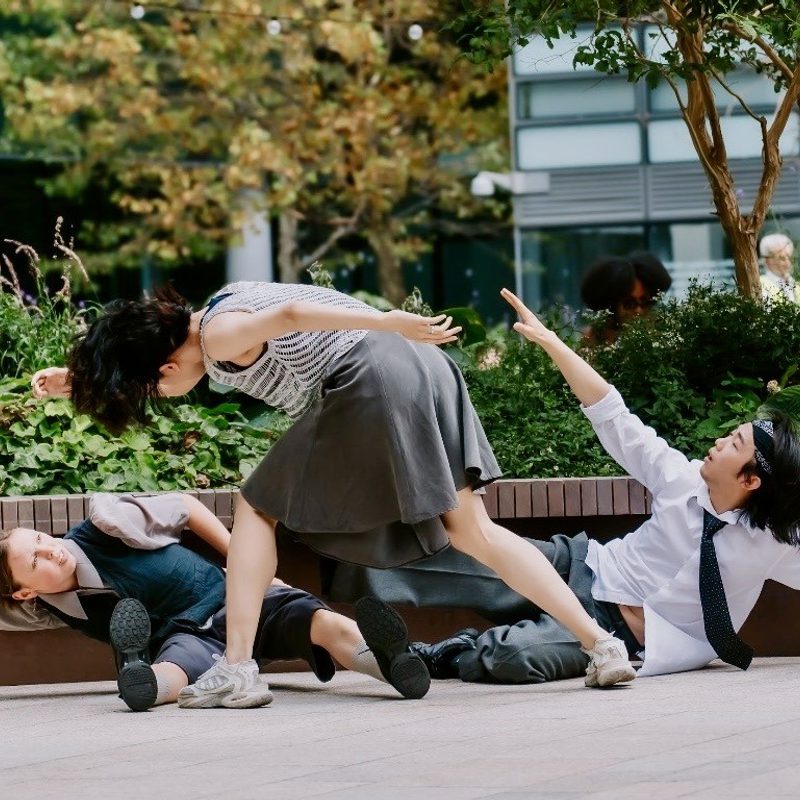
At Regent’s Place, Fangas guided the dancers through a series of explorations focused on the relationship between the collective body and space. The creative process began with a circular formation, where dancers established a shared sense of group awareness through synchronized and repetitive movement patterns. Within this circular structure, all dancers oriented toward a common spatial focus, creating a clear sense of collective order and centripetal spatial organization.
As the process unfolded, the formation gradually shifted from a circle into linear arrangements. The spatial relationships that had initially drawn dancers inward began to expand outward, generating new directions, pathways, and possibilities for movement. Fangas then further divided the ensemble into duets and small groups of three or four dancers. Through the interactions and transitions between these smaller groupings, multiple spatial focal points emerged, creating a richer and more layered spatial landscape.
From a spatial perspective, this choreographic process revealed a gradual transition from a singular spatial orientation toward a more multidirectional use of space. Rather than maintaining a unified facing direction or shared orientation, dancers navigated between different pathways, directions, and group relationships. Through continual reconfiguration and regrouping, the space became increasingly fluid, open, and decentralized, allowing multiple centers of activity to coexist simultaneously.
Toward the end of the creative sequence, Fangas organized the dancers into a square formation with one performer positioned at the centre. This geometrically structured arrangement established a strong visual focus and spatial hierarchy within the open outdoor environment. Even in a site without clearly defined stage boundaries, the choreographer used formal composition to create a sense of order and spatial clarity.
What I found particularly interesting was that, despite the highly structured formations, the dancers were not confined to a single viewing direction. Instead, they continuously projected their movement, gaze, and attention outward in multiple directions, allowing their kinetic energy to radiate throughout the surrounding environment. This multidirectional awareness seemed to respond directly to the openness and complexity of the outdoor setting.
Throughout the process, the dancers’ bodies were not simply oriented toward an imagined front or a conventional stage perspective. Rather, they established an ongoing dialogue with the surrounding environment, creating a more expansive relationship between body and place. The work appeared to balance structure and openness, revealing how an outdoor site can become an active participant in choreographic thinking rather than merely a backdrop for performance.
by Huang Shu Lien (Scholar)
Posted by