Blog post
The 2026 London ArtsCross presents 8 outdoor performances (July 10th 12:30 at Regent’s Place, and 16:00 at Russell Square) under the theme of ‘Out of Place’ (舞越異境 in traditional Chinese, or 舞越异境 in simplified Chinese).The theme in traditional Chinese indicates dancing cross the ‘strange realm’. The traditional Chinese character for ‘strange’ (異) is the combination of two characters: ‘field’ (田, in the form of 4 squares) on top of ‘share’ (共). This matches the joint venture of 4 cities in ArtsCross and the spirit of ‘harmony in diversity’ (和而不同).
2026年倫敦「跨藝」計畫(ArtsCross)以 ‘Out of Place’(繁體中文:舞越異境,簡體中文:舞越异境)為主題,呈現8場戶外表演(7月10日12:30在攝政廣場,16:00在羅素廣場)。繁體中文的主題意指舞蹈跨越「異域」。 「異」字是由在上方的「田」(由四個方格組成)和在下方的「共」兩個字組成,這與「跨藝」計畫由四個城市聯合參與,以及「和而不同」的精神相契合。
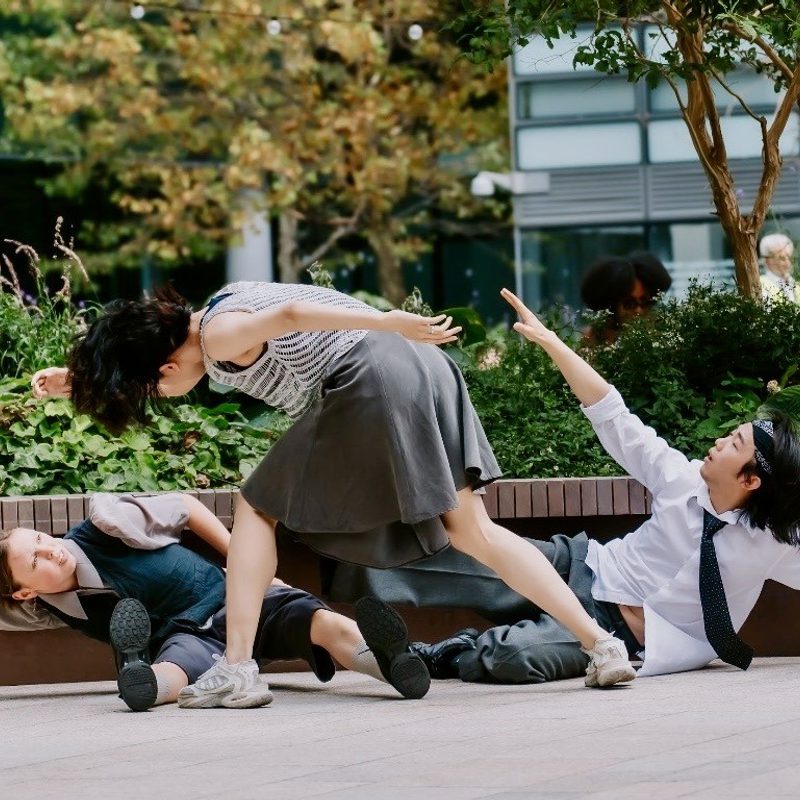
In the period of three weeks, dance artists from four cities (in particular eight choreographers and their selected dancers) worked under time pressure and heat waves, to create experimental, collaborative and intercultural works. For them, the English theme ‘Out of Place’ can be taken literally, meaning performing their dance works outside of the traditional theatre, black box or dance studios. After lengthy exploration and negotiation, alternative space, in this year’s case urban settings, such as Regent’s Place (a business plaza in Euston) and Russell Square (a Georgian garden in Bloomsbury) are secured for the 8 outdoor site-specific performances.
在三週的時間裡,來自四個城市的舞蹈藝術家(特別是八位編舞家及其挑選的舞者)在時間和熱浪的雙重壓力下,創作出實驗性、合作性和跨文化的作品。對他們來說,本計劃的英文主題 ‘Out of Place’ 可作字面理解,意指在傳統劇場、黑盒子劇場或舞蹈工作室外進行舞蹈表演。經過長時間的探索和協商,最終確定了替代空間,今年的演出場地為城市景觀,例如尤斯頓(Euston)的攝政廣場(Regent’s Place)和布魯姆斯伯里(Bloomsbury)的羅素廣場(Russell Square)。這八場戶外特定場域演出,均在此舉行。
For visiting dance artists and locals alike, this intense project with it’s intentional mixing of groups and breaking of boundaries, generates uncertain conditions, hybrid creations and alternative solutions. Everyone involved are genuinely ‘out of place’. They are out of their comfort zone. The visitors are not in their original time zone. They do not live in their familiar linguistic, cultural, and societal territory. The intense heat certainly made the locals feel very tropical.
對於來訪和當地的舞蹈藝術家來說,這個刻意融合不同群體、打破界限的密集項目,催生了不確定的局面、混血的創作和另類的解決方案。所有參與者都感到格格不入,離開了舒適圈。來訪者不在原本的時區,也不在他們熟悉的語言、文化和社會環境中。而酷熱的天氣,無疑讓在地人士感受到了濃厚的熱帶風情。
Testing the water is essential.
Exploration is fundamental.
Adaptation is foundational.
Adjustment is normal.
Both the choreographer and the dancer are navigating the troubled water of ‘arts’, and trying to ‘cross’ this river of constant state of flux.
試探水溫至關重要。
探索是根本。
適應是基礎。
調整是常態。
編舞家和舞者都在「藝術」這片波濤洶湧的水域中航行,試圖「渡過」這條不斷變化的河流。
Thus, as an observing scholar, I am interested in the practice of ‘fluidity’. I am curious about how it is adopted, initiated, facilitated or embodied by the dance artists. 因此,作為一名觀察學者,我對「流動性」的操作很感興趣。我很好奇舞蹈藝術家們是如何採納、發起、促進或體現這種「流動性」。
~~~~~~~~~~~~~~~~~~~~~~~~~~~~~
Note(註):
The term ‘fluidity’ primarily encompasses mobility, smoothness, and variability.
「流動性」的含義主要包括移動性、流暢性和變易性。
The specific meaning depends on the context.
具體的含義取決於語境。
In physics and chemistry: it refers to the fluidity of matter, that is, the property of matter being easily movable. (e.g., water has good fluidity.)
在物理和化學:它指的是物質的流動性,也就是物質易於移動的特性。(例如,水的流動性佳)。
In action, language, or art: it refers to fluency or smoothness (e.g., graceful dance moves, fluent language expression).
在行動、語言或藝術:它指的是流暢或順暢(例如,優雅的舞蹈動作,流利的語言表達)。
In economics or finance: it refers to the liquidity (e.g., ability to convert assets into cash).
在經濟或金融:它指的是流動性(例如,將資產轉化為現金的能力)。
In states and situations: it refers to the uncertainty, variability, or flexibility of things (e.g., unpredictable changes in the situation).
在國家與機構:它指的是事物的不確定性、易變性或靈活性(例如,局勢變化不定)
By Yu-Ling Chao
Posted by