Blog post
It is my first time participating in ArtsCross London 2026, and it has truly been a pleasure. These three weeks have been filled with both joy and challenge. One of the main challenges both dancers and choreographers faced was the heat wave. However, I am grateful for it, as it unexpectedly gave me an extra day and a half to pause, refine, and further develop my ideas. Nonetheless, I appreciate the rewarding process that was wrapped within a few weeks as the outcome of the choreography blossomed from the time spent working together.
Originally, I arrived with some initial concepts. However, once I met my dancers and visited the site, I decided to let go of my original plan. I realised that here, in London, the site and the dancers themselves are not meant to fit within the mould I had imagined but hold their own individual characteristics. This reveal of individuality and the unique self became my most significant inspiration.
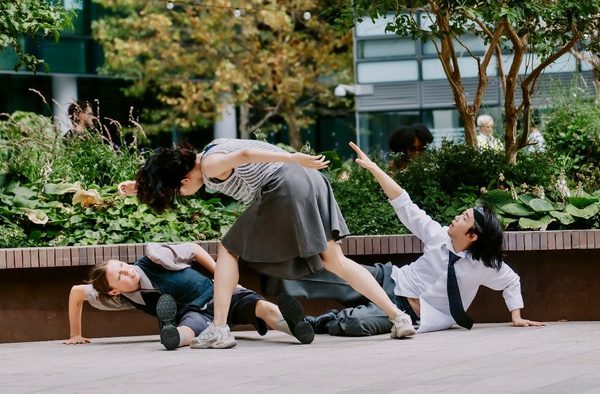
Eventually, the mix of this year’s ArtsCross theme “Out of Place” and ideas strung a final proposal. I decided to look upon the lives of humans and how we are squashed by the expectations and confinements of society, like a bird trapped in a cage unable to fly freely. Many people long to escape this environment, even if only briefly — to find a moment of rest or to enter a different mental or physical space where they can breathe freely. Yet such moments are temporary; reality inevitably calls them back to their daily lives.
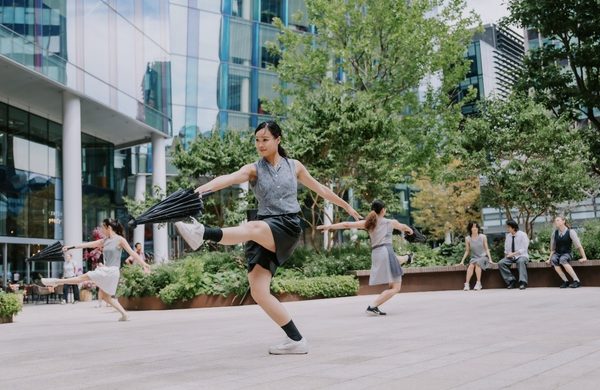
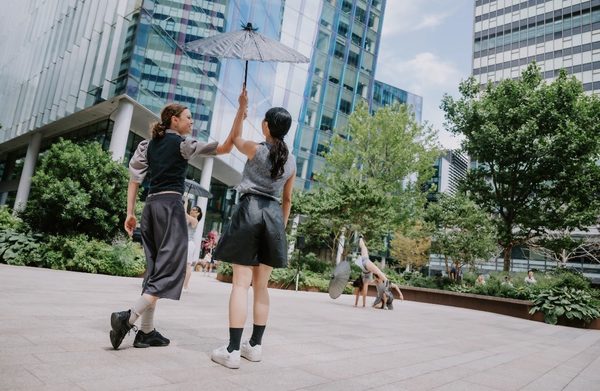
To choose a commercial district, I looked for the surrounding rows of office buildings as the setting for my work. Through this urban landscape, I aim to capture the pace, atmosphere, and emotional state of people living and working in the city. Modern urban life is often defined by constant pressure and demanding routines, creating a sense of tension and confinement. To enhance this meaning, I introduced the oil-paper umbrellas as a prop. The umbrella creates a space beneath that becomes a metaphorical refuge — a temporary shelter where urban dwellers can momentarily step away from reality and catch their breath. One of the reasons I brought the oil-paper umbrella from Hong Kong to London was in response to this year’s ArtsCross theme, “Out of Place.” To me, the umbrella carries a subtle sense of displacement within a Western commercial district. By situating an object deeply rooted in Eastern culture within this context, I intentionally created a feeling of dislocation, echoing the theme of the project. Through this work, I deliberately established a sense of visual contrast to explore the tension between the desire to escape and the inevitability of returning to the rhythms of contemporary urban life.
Bringing an object from Eastern culture into a Western context does not mean I intend to impose it on a Western stage or insist on its continued use. In this work, it is simply a stage prop. I believe any prop can hold multiple possibilities. Here, it serves a metaphorical purpose — nothing more, nothing less.
In the article “Week 1: Appropriation or Respect?”, Adriana Garcia Pinilla reflects on cultural exchange in dance, exploring the delicate balance between respect and appropriation. She emphasises the importance of humility, curiosity, and reflective learning when engaging with traditions beyond one’s own culture. In her observations of my rehearsal process, she noted that my work with umbrellas appeared to have “a heavy base in Chinese traditional dance forms.”
I appreciate the intention behind this reflection, as questions of cultural responsibility are both important and necessary. However, I would like to clarify that my choreography is not grounded in traditional Chinese dance vocabulary. While certain movement qualities or the umbrella itself may evoke associations with Chinese culture, this was never the structural foundation of the work. The movement language emerges from a contemporary practice shaped by the site, the dancers, and the collaborative process in London. Similarly, this judgement was rooted early, as this was documented during the first week without any conversation behind the plan’s thought-process. Still, I understand that since the meaning of the choreography was not fully obvious on what I hoped to share, as it was still the beginning and unrefined.
When we encounter something unfamiliar, it is natural to form immediate impressions. We may assign it fixed meanings or interpret it through our own perspectives, which are subjective. Perhaps the value of cultural exchange lies precisely in this space of ambiguity — where meanings remain open, and dialogue allows us to move beyond our first assumptions.
Coming from the East to create work in a Western context inevitably raises questions for me: Should I adapt my work to fit a local aesthetic? Should I modify my artistic language to be more easily understood or accepted? Or should I remain true to my own artistic voice while continuing to explore and challenge it through dialogue with different cultures? Perhaps I am overthinking it. In the end, I choose simply to create the work I believe in.
For me, ArtsCross is not about representing or reproducing a culture in its “pure” form. It is about creating a space where different cultural perspectives can meet, influence one another, and generate new artistic possibilities.
I believe art should be open and inclusive. That, to me, is exactly what ArtsCross embodies — cultural exchange. With four dance academies participating, three of them from the East, the meeting of Eastern and Western cultures feels both natural and inevitable.
Perhaps we do not need to resolve every question about culture and identity so quickly. Perhaps it is enough to remain attentive, respectful, and open. Art does not always provide answers. Sometimes, it simply creates a space to pause — and to breathe.
Written by Pik Yim Yu – Choreographer from the Hong Kong Academy for Performing Arts
Posted by