Press Story
7 Sept 2026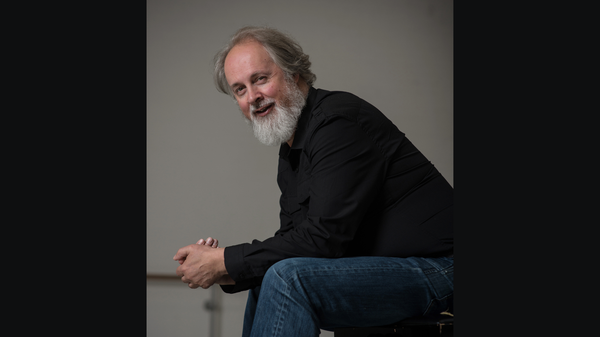
Written by Suzanne Frost
Long before Richard Alston discovered Merce Cunningham, founded a dance company or became one of Britain's most celebrated choreographers, he discovered music. As a schoolboy at Eton, he found refuge in the library, quietly working his way through its record collection. One by one, he listened to everything, voraciously and without prejudice. It was the beginning of a lifelong conversation with music, one that would shape every dance he ever made.
"I always have the music," he once said when asked what happened if he got stuck making a dance. Music was never accompaniment, nor merely inspiration. It was the architecture of his dances. He didn't impose movement onto a score so much as uncover the textures and conversations already hidden inside it. Few choreographers possessed such profound musical intelligence. Bach, Monteverdi, Britten, jazz, Steve Reich – each revealed a different world of shapes, rhythms and possibilities. It remains one of life's quiet paradoxes that as his hearing deteriorated, the musicality of his dances never diminished. If anything, they seemed to become an even purer expression of a relationship with music that had long transcended listening alone.
Richard believed in beauty. Not beauty as decoration, but beauty as an artistic value in itself. Making something graceful was not a retreat from the world, but his way of enriching it. Where contemporary art is increasingly expected to tell us something about politics, identity or the state of the world, Richard sought something different. His dances rarely told stories. Their emotional world was understated; their dancers' faces serene, often almost impassive. Instead, meaning emerged through proportion, musicality and form. Through the curve of an arm. The architecture of bodies in space. The exact moment a phrase met the score. Richard Alston’s dances unfolded more like paintings than theatre. They invited attention rather than interpretation.
At times, this steadfast commitment to his own artistic convictions left him unfashionable. Some found his work too refined, too elegant, too restrained. A reviewer once mischievously likened his choreography to Waitrose: impeccably crafted, dependable, always of the highest quality. Richard protested the comparison, yet there was a grain of truth in it. Audiences knew that a Richard Alston dance would be crafted with extraordinary intelligence and care, with glorious music and performed by impeccably skilled dancers. He spent a lifetime refining an aesthetic that was unmistakably his own. At a time when contemporary dance increasingly rewarded disruption, Richard remained steadfast in his belief that proportion, musicality and grace were not relics but living artistic values. “I don't want to be cutting-edge”, he is quoted in the New York Times in 2004, “To move in an art form, you don't have to push at the edges; you can dig down into the stuff itself.''
Richard made dances. He never spoke of choreography. Over more than half a century he created over 200 of them, becoming one of Britain’s most important and defining artistic voices of contemporary dance.
Born in Sussex in 1948, he left Eton at 16 to study at Croydon Art College, before he found his way to a dance studio in Berner’s Place, off Oxford Street, becoming one of the earliest students of the newly formed London School of Contemporary Dance as it was then called, before later moving to its permanent home at The Place, alongside Robert Cohan’s company, London Contemporary Dance Theatre, and eventually being renamed London Contemporary Dance School. He would often describe The Place in the 60s and 70s with a sense of wonder – a creative playground with a leaky roof, bullet holes from the Second World War still scarring the walls, yet every room occupied by someone attempting an entirely different artistic experiment: avant-garde musicians, actors, filmmakers, and young artists wandered between studios with the conviction that anything was possible. Many of The Place’s earliest alumni – among them Dame Siobhan Davies, whose long career has often coincided or intersected with Alston's – became lifelong friends, colleagues and collaborators; a generation of artists given the rare freedom to dream, experiment and imagine a future for British contemporary dance that did not yet exist.
After only three months at London Contemporary Dance School. he choreographed his first work, Transit, and by his third year was organising fellow students to tour schools, colleges and universities introducing audiences to Graham technique. After founding his first company, Strider, from 1972 - 75, Richard travelled to New York to study with Merce Cunningham, whose influence would remain fundamental throughout his life. While in the states, he experienced a breadth of dance – from Trisha Brown to Bournonville and Balanchine – that would influence his work, alongside the British ballet choreographer Frederick Ashton, whose work he would always single out as a core inspiration. Returning to Britain, he established himself as one of the country's most distinctive choreographic voices, serving first as Resident Choreographer and later Artistic Director of Ballet Rambert. During twelve transformative years with the company, he created twenty-five dances and oversaw its evolution into Rambert Dance Company, while also making work for The Royal Ballet, the Royal Danish Ballet and companies across Europe.
When he returned to The Place as Artistic Director from 1994 - 2020, he not only established the Richard Alston Dance Company as resident company, he transformed The Place’s artistic profile and educational philosophy. Alongside colleagues including Mary Evelyn, Kate Price and Jeannie Steele, he championed Cunningham Technique within London Contemporary Dance School, profoundly influencing the way generations of dancers came to think about musicality, space and movement. LCDS alum Liam Riddick, with his extraordinary musicality and effortless lyricism, became one of the defining interpreters of Alston's choreography, and Martin Lawrance, who joined RADC as a dancer in 1995, accompanied Richard and the company until it’s closure, as both rehearsal director and resident associate choreographer. Under Richard’s leadership, the company built an extensive education programme, taking dance into schools across the UK and internationally. A natural teacher, nurturing the next generation of talent was important to Richard, and doubtlessly influenced many young people to pursue dance as a career. His influence remains woven into the fabric of London Contemporary Dance School, where up until 2026 former company dancers continue to return to teach Alston repertoire to first year BA students, allowing them to discover that beneath its apparent simplicity lies astonishing complexity. Even in his final weeks, from hospital, Richard was watching videos of London Contemporary Dance School students rehearsing his dances, sending back detailed notes and encouragement.
He cut a striking figure – tall, silver-haired and bearded - and carried himself with the authority of an elder statesman. Without his hearing aids he would drift serenely through theatre foyers and corridors, apparently oblivious to the conversations unfolding around him, part maestro, part absent minded professor. Yet placed in front of an audience he was able to put anyone under is spell. Unlike most speakers, Richard rarely prepared, trusting instead that the right words would emerge. There was always a delicious sense of uncertainty. What anecdote might suddenly emerge? What unexpected opinion? Yet audiences were invariably captivated. His thoughts unfolded with the same elegance and clarity as his dances, and his programme notes and essays remain among the finest writing produced by any British choreographer.
He had a wonderfully dry wit and mischievous appreciation of life's absurdities. After receiving his knighthood in 2019, he delighted in recounting the ceremony at Buckingham Palace. Dressed impeccably in white tie and tails - but wearing a cumbersome medical boot after rupturing his Achilles tendon- he was congratulated by the then Prince Charles, who warmly expressed the hope that the honour might "encourage" him. At seventy, after transforming British contemporary dance for decades, he revelled in the possibility that he was apparently still considered a promising young artist.
Richard Alston leaves behind an extraordinary body of work, but his legacy cannot be measured by honours or dances alone. It lives in the dancers who still carry his movement in their bodies. In the students who continue to discover that music can be seen as well as heard. In the generations of artists who inherited from him an uncompromising belief in clarity, craftsmanship and beauty.
Sir Richard Alston spent a lifetime listening. And making what he heard visible through dance.
Read an obituary by Alastair Macaulay here.
Richard's incredible body of work is also celebrated and preserved through the Richard Alston Foundation. Find out more here.
We know Richard was admired and loved by many across our community. We will be gathering tributes to Richard and his work here on our website. If you would like to contribute your memories, please send your message to Suzanne.Frost@theplace.org.uk