More than a dance: An introduction to Butoh

News Story
This autumn, The Place presents Rebellious Bodies, its first-ever festival dedicated to Butoh, bringing together five exceptional artists from Japan for two days of performances celebrating one of contemporary dance's most influential – and often misunderstood – art forms.
For many UK audiences, Butoh remains unfamiliar territory. Emerging in Japan in the late 1950s, Butoh challenged the conventions of dance, theatre and performance. More than 60 years later, it continues to evolve, resisting easy definitions.
"For me, Butoh is more like a philosophy than a dance form," says festival curator Maï Burns.
As a dance, Butoh resists codification. There are no fixed steps and no prescribed way of performing. Every artist develops their own approach, often drawing on improvisation, imagery and deeply personal experience.
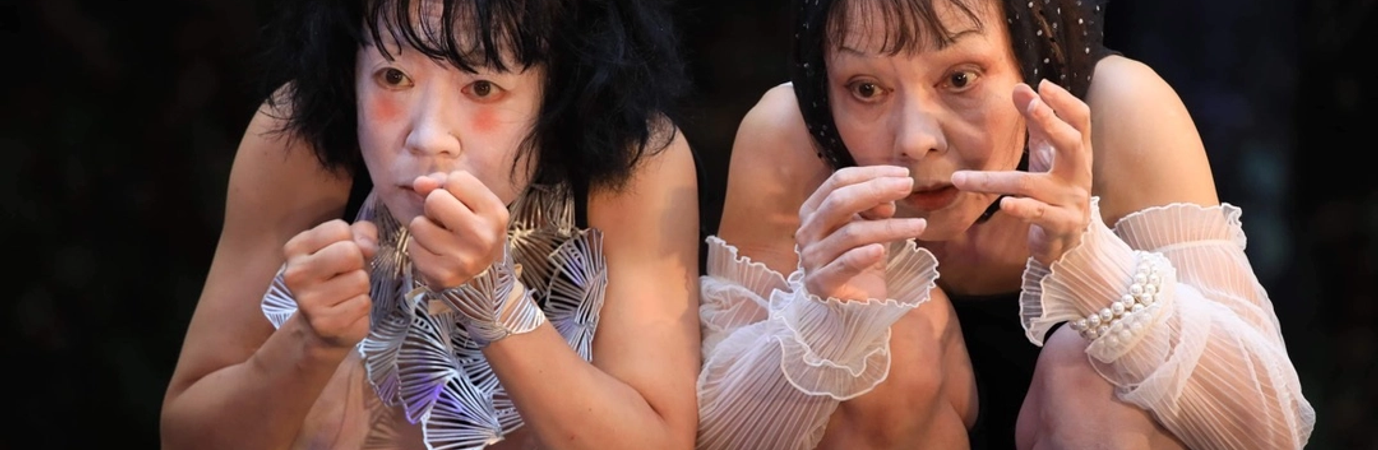
Yet Butoh does have a visual identity that many people recognise. White-painted bodies, shaved heads and slow, otherworldly movement have become its most familiar image, popularised in part by companies such as Sankai Juku. But a visual aesthetic is the least important feature of Butoh. The appearance grows from the work rather than defining it. For some artists, white body paint is a way of masking or erasing the self; for others it carries deeply personal symbolism, while many performers dispense with it altogether. As with every aspect of Butoh, the outward form is shaped by an inner process of imagination, presence and transformation.
A Butoh class typically lasts several hours, allowing students to journey inward. Rather than learning codified movements, dancers work through imagery, improvisation and carefully constructed prompts – an approach that seems more aligned with the acting pedagogy of Jacques Lecoq than the average contemporary dance technique class. It is perhaps no surprise, then, that the always eagerly avant-garde cultural scene in France has embraced Butoh so enthusiastically. In the UK, by contrast, opportunities to study or see it performed remain rare.
To understand Butoh's significance, it helps to think about its pioneers in the same way contemporary dance audiences might think about Martha Graham. If Graham transformed modern dance in America, Kazuo Ohno occupies a similarly influential place in the history of Butoh. Alongside Tatsumi Hijikata, he helped shape the art form before inspiring generations of dancers from around the world to travel to Japan and study with him and his collaborators.
The Place has its own connection to that history. Kazuo Ohno performed here in 1980 and again in 1986, introducing UK audiences to a movement that was still in its infancy. This autumn, one of Ohno’s most dedicated long-time students, Mitsuyo Uesugi, who performed alongside him at The Place in 1980, returns 46 years later alongside four fellow artists who have in turn been inspired by her own practice. Together they form a direct artistic lineage to Kazuo Ohno.
While they have collaborated in different combinations over the years, Mother Forest marks the first time all five performers have appeared onstage at the same time.
For Burns, that lineage is deeply personal. She moved to Japan in 2016 to study Butoh, first with Yoshito Ohno, Kazuo Ohno's son, and later with Mitsuyo Uesugi, spending seven years immersed in the community that surrounds the art form. Yet despite Butoh's rich history, Burns believes its relevance lies firmly in the present. "It's easy to explain Butoh through its origins in post-war Japan," she says. "But that's not why these artists perform today."
Instead, she believes Butoh offers something increasingly rare: a way of paying close attention to the body. At a time when so much of our lives is mediated through screens, algorithms and artificial intelligence, Butoh invites us back into physical experience—to notice breath, weight, memory and our connection to the spaces and people around us. It asks us to reconnect with something immediate and tangible: the ground beneath our feet and the traces of those who came before us.
That spirit of curiosity and experimentation runs through the festival. Alongside a programme of solo works, audiences will experience Mother Forest – a new collaboration created especially for this gathering of artists. Rooted in a shared artistic heritage but looking firmly towards the future, it reflects Butoh's enduring ability to reinvent itself.
Whether you're encountering Butoh for the first time or returning with fresh eyes, Rebellious Bodies offers something rare: the chance to experience a living artistic tradition carried across generations, continually reinventing itself while remaining rooted in a profound curiosity about what it means to inhabit a body.