News Story
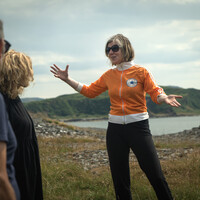
Alongside her celebrated career in dance education, Dr Lise Uytterhoeven’s research focuses on humour, joy, and drawing on the variety of choreographic work happening at The Place.
After leaving her native Belgium to gain a degree in dance education in the Netherlands, Dr Lise Uytterhoeven went on to work with children of all ages, as well as adult learners. Gradually transitioning into the theoretical study of dance through dance analysis, dance history and performance theory, Lise moved to the UK to study for her Master’s, and subsequently her PhD. She started working as a lecturer in 2006, and progressed through the ranks at London Studio Centre to become Head of Learning and Teaching. She joined The Place in 2020 as Director of Dance Studies.
In research terms, Lise’s PhD focused on the work of the Belgian choreographer Sidi Larbi Cherkaoui, an associate artist at Sadler’s Wells who is globally celebrated for his work in dance theatre, musical theatre, circus, opera and music videos. Through the PhD, Lise explored cultural issues such as national identity, religion, language and how spectators engage with choreography. Fascinated by the breadth of choreographic work being produced and performed at The Place, Lise’s evolving research interests are based on two underexplored themes in dance: humour, and joy.
Humour and joy in dance
“The way humour works in choreography is very different from the way humour works in language, and there is very little written about this,” Lise explained. “Contemporary choreography is doing something very different. While a verbal joke tends to stop after the punchline, I’m discovering there’s a whole world of delight and pleasure that happens after the punchline in dance-based jokes.”
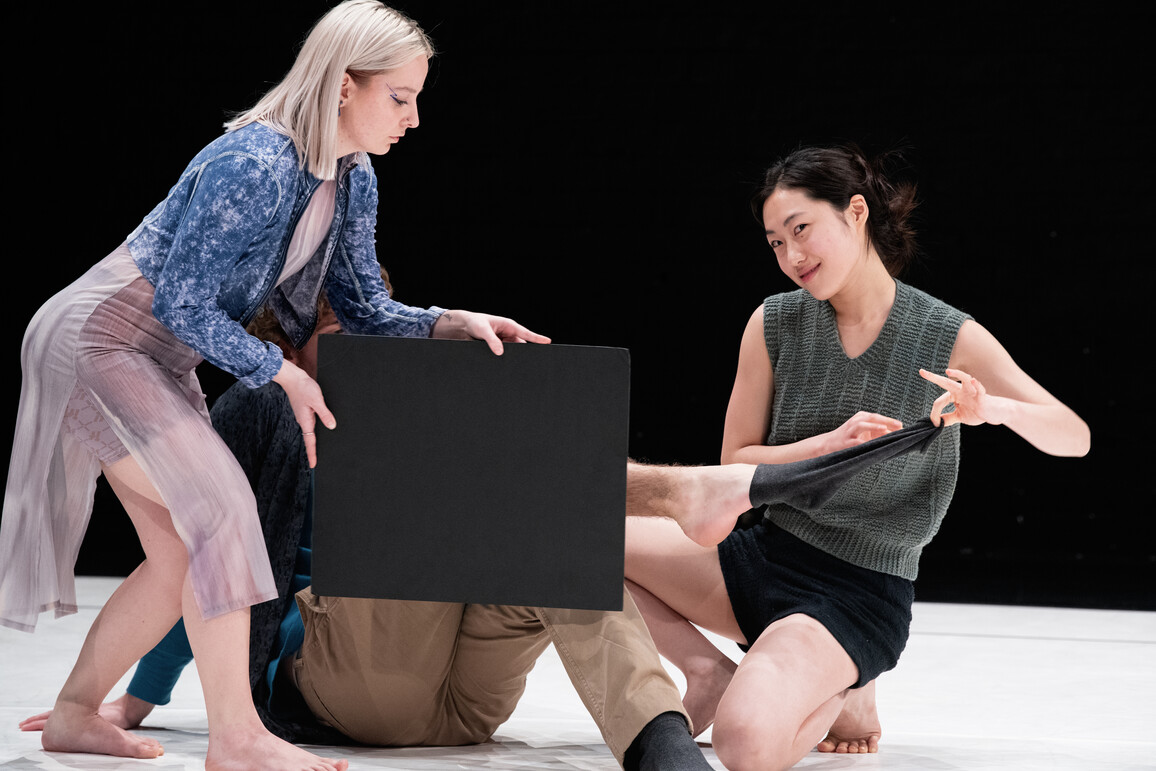
Lise has been looking towards the work of a variety of choreographers to understand more about this, including Igor and Moreno – world-renowned choreographers and alumni of The Place. In their TAME GAME piece, which they recreated with students at London Contemporary Dance School at The Place in 2023, there’s a scene where a female performer is looking at a male performer’s foot with a sock on it, as if it’s an object of sexual desire. When the sock is pulled off, a censor board is held in front of it. The joke doesn’t stop there, as other performers remove clothes to reveal body parts the performers pretend need to be covered by the censor board too. “It's really funny, and the person holding the board needs to go to greater lengths to be successful at covering up the ‘obscene’ body part,” Lise said. “You see them playing this game, and they butt up against the materiality of the body. There’s a whole world of delight and pleasure when you see them play out that game, even after the punchline has happened.”
Modern times mean now is a good moment to be exploring humour in dance. “People reach for humour in times of crisis,” Lise said. “We’re facing environmental, political and humanitarian crises at the moment, plus all sorts of UK-specific issues. I think we need to understand more about how people engage with dance when they’re watching it. How is the spectator experiencing embodied humour they’re encountering on stage? How does it get them to think about specific questions in different ways? These are all questions I’m interested in researching.”
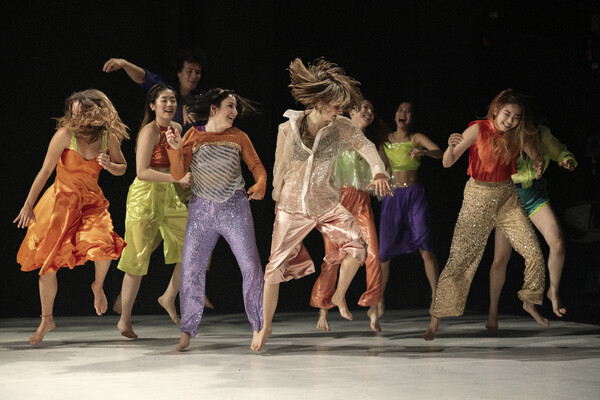
Joy is another theme Lise has noticed choreographers and students at The Place are becoming more interested in. This was particularly inspired by the piece Stories of us but all at once, which students created with the Korean artist Sung Im Her. “The colour and the movements were infectious to watch,” Lise said. “But what was dripping off it was the joy of the performers to be dancing that work together.”
Another inspiration for this line of research was The Picnic, a piece by Eva Recacha performed by students from The Place at Sadler’s Wells, which takes a painting – The Garden of Earthly Delights by Bosch – as a starting point. “It was like being inside that painting, where people are pursuing pleasure and having a place to be themselves and be accepted,” Lise said. “When the students described their experience of taking part in this, a lot of them said things around joy.”
For Lise, pursuing this as a research strand draws on decolonial theory, and how radical joy and pleasure activism can be tools to resist the oppressive pressures that surround you. She gave a paper at the transdisciplinary conference, Do we even know what is going on? Performance in Higher Education and Beyond: Rethinking Norms, at University of Zagreb on this topic, and is pursuing it further as she sees more artists and students take an interest in this. “There are a lot of things troubling students and artists about the state of dance education, the wider industry, and the world at large,” Lise said. “They’re discovering and articulating what their values are and how they fit into these worlds. They’re negotiating a lot, but they’re all really interested in a sense of belonging and community.”
Harnessing a powerful art form
Engaging with dance – whether to discover joy, humour or something else – requires the audience to interpret and find meaning. Lise believes the absence of the verbal opens up space for interpretation and ambiguity, which is important in the world today. “Engaging with dance and interpreting it is a complex thing, and I feel that being able to tolerate complexity and deal with it is a skill that’s hugely needed in the world today,” she said. “Multiple different realities can exist alongside each other, and there's value in listening to each other about those differences. Dance can really help nurture the idea that there isn't one correct reading of something.”
The ecology of The Place – its networks, skills and expertise – is rich ground for pursuing different aspects of dance research. “The conditions that are created at The Place for artistic production and artistic creation are second to none,” Lise said. “In the UK and worldwide, we are leaders in how we support artists to create work.”
Lise believes tapping into this has huge potential for the future of dance research. “I'm a firm advocate for the value and the power of dance,” Lise said. “It can really feed into people's health and wellbeing, the development of skills in young people, and it has the power to support people at various life stages and transitions, whether that’s parenthood or ageing. I think it's one of the most under-explored and under-exploited art forms.”