News Story
As a prominent expert in screendance for 40 years, Dr Katrina McPherson’s research focuses on the intersection between dance and the moving image, and how practice research can push the artform forward.
Having gained a dance degree in the 1980s, Katrina McPherson initially envisaged a career as a choreographer, before a desire to bring dance to a wide audience lead to her developing an interest in dance for television. Despite the prevalence of broadcast dance at the time, there were no options for learning the practice. Achieving a postgraduate degree in video art, Katrina went on to become a television director and one of the first hybrid ‘video dance’ artists, continuously developing her teaching in parallel to this. Katrina’s book Making Video Dance – a step by step guide to creating dance for the screen was first published by Routledge in 2006, with the second edition coming out in 2018 and a third edition underway. Katrina subsequently gained a PhD by publication, which explores how her screendance practice – films and writing – feeds into pedagogy. Over the past decades, Katrina has been instrumental in raising the bar in the critical discourse around screendance as an interdisciplinary art form, organising symposia and community-building events, and co-founding The International Journal of Screendance in 2010. Katrina joined The Place in 2022 as the course leader of the MA Screendance.
Katrina’s research focus is on the body in movement in different forms, primarily through single screen films, but also installation and interactive work. Through her work as a director and cinematographer, she questions who is behind the camera, who is in front of the camera, and who has agency in that situation, highlighting ideas around the empowerment of the performers and democratising working practices.
Screendance, relationships and perception
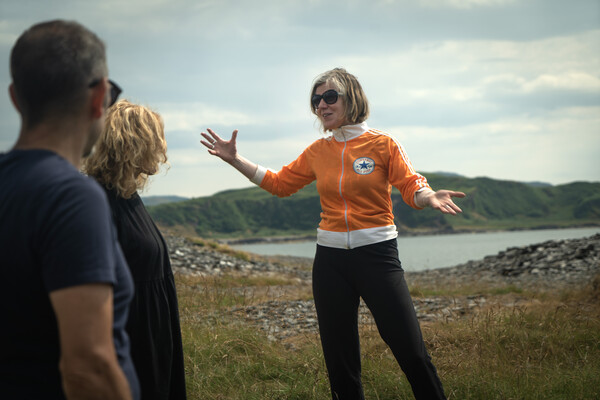
“The filmmaking process can take a viewer into an experience of the moving body. Whatever that body is, whoever that body is. This affects and challenges notions of how we perceive and relate to each other. My work is always about engagement and relationship. This can be with people in front of the camera, behind the camera, with the viewer and in the relationship between people working together.”
These ideas fed into one of Katrina’s recent projects, which draws on narratives around her grandmother’s life and her own life. She considered the stories within her body when she’s behind the camera, and how she leans into other people’s stories as a filmmaker. Katrina says that even specific pieces of work like this always lead her back to a bigger research question: “How do the elements of screendance – the camera, the editing, the mise-en-scène – support our understanding of narrative and reality and relationships between people and their environments.”
Over time, Katrina has learned, adapted and discovered through her practice and work in screendance. This led to the development and publication of her book, Making Video Dance, which is a widely used resource for people involved in the industry. However, Katrina sees this discipline as something that inherently needs to be challenged and re-interpreted, particularly given the rapid changes in technology and the use of screens.
“If it purely becomes about the end product, then things are replicated without any potential for moving ideas, forms and communication forward,” Katrina explained. “I’ve remained engaged in screendance for years because I see it as a space for experimentation. When making work, you can continuously ask what you can bring to the process, how you can challenge that process, and how you can push the form forward.”
The importance of practice research
Katrina’s research is published in many formats. A third edition of her book is underway, and Katrina has a longstanding relationship with the Jumping Frames festival in Hong Kong, where her work will be featured as an Artist Collection event in November 2025. She is currently working on a new film with the improvising dance artist Kirstie Simpson. They made the documentary, Force of Nature in 2011, and they’re now developing a new piece of work about their creative journeys since then.
The Place as an organisation has “threads of screendance throughout its history” and Katrina sees how it’s a hub where people come together with their individual experiences to innovate. “Given the location of The Place physically – but also in people's awareness – I think it’s a really important centre for screendance internationally,” she said. The teaching process and student body have important contributions to make too. Katrina’s own teaching does not set out to be prescriptive, but rather encourages students to ask questions, interrogate and reflect. How they engage with the course material, the guest lecturers they have contact with, and their own ideas are all part of the future evolution of screendance.
Katrina believes practice research is a powerful way to lead screendance forward. “We’re making, but we’re interrogating what we’re making in a particular way too,” she said. “That’s practice research. And without practice research, we cannot move the art form forward. Why do we need to move it forward? Because we need to keep relevant, open and engaged with contemporary culture and the future, while understanding where we've come from. Practice embodies all this and more! For me personally, as long as there are artists researching, creating and asking questions, I’m a lot less frightened about things like AI.”