News Story
How did you discover contemporary dance?
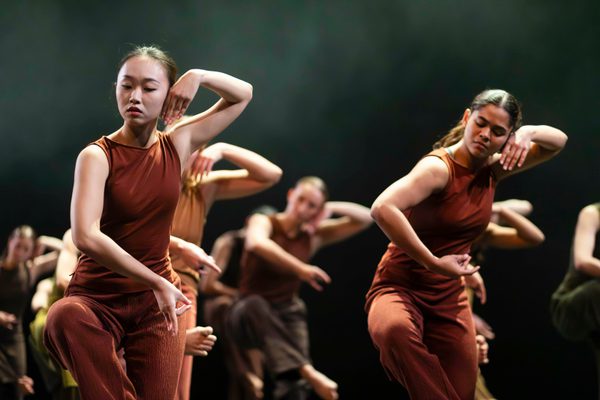
I began dancing at a very young age, starting with Bharatnatyam and later on with ballet and jazz. My introduction to contemporary dance came much later in my training, mainly because it was always a style that I shied away from. It was only about 6 years ago that I joined a contemporary class in my dance school back in Mumbai. I wouldn’t say it was movement that I instantly found myself in. It felt unnatural for me to let go of all the structure that was embedded in my body from all my ballet and jazz training - and sometimes it still does! It grew on me slowly but surely. Over the past three years, contemporary has become central to my practice as a dancer and especially as a performer. With the Indian Youth Dance Company, I was able to explore my embodiment of contemporary dance through performances and shows across India and London. I learnt the basic elements of contemporary in class but I think that I was able to discover it more on stage. It will always be the style that pushes me out of my comfort zone, but it has unfolded to be an essential vessel through which I tell stories through my body.
How did you find out about the LCDS recruitment workshop in Mumbai?
The LCDS recruitment workshop actually took place in my dance school, the Institute of Classical and Modern Dance, India. In 2024, the year before, I also got the opportunity to do a performance intensive at LCDS through which I was able to find out what the school offered and what it stood for within the dance community in London. So, I was also looking out for audition opportunities on the LCDS website.
Being able to do an in-person workshop in Mumbai was very helpful for me in getting to know the faculty and giving me a glimpse into what both the MA and BA programs would be like. Very few international dance schools hold in-person auditions in India, but if given a chance, I think it is definitely worth attending, because as much as the school is auditioning you, you are also auditioning the school - does it align with your future goals? Is the training and motivational environment one you believe can push you artistically? All these questions are so much easier to answer in an in-person audition. And a bonus - the faculty are able to watch you dance and get to know you personally rather than through a screen.
The recruitment workshop was structured in a way that really gave me the space to be myself. For the BA workshop, we did about three classes in the various styles that are taught within the program and for the MA workshop we were able to take class with course leader Tom English and learnt repertoire from Aishwarya Raut.
I believe you had quite a few offers - what made you decide on LCDS?
Yes! I had offers from universities across the US and UK. I had applied to a range of schools whose programs offered me specialisation in styles such as musical theatre, commercial dance, modern dance and contemporary. There were multiple factors I had to consider. Apart from financial considerations, visa application processes and deciding between the US and UK (each country has something different to offer dancers), I also had to consider how studying within an undergraduate or postgraduate setting would differ in shaping the rest of my career. Ultimately, I chose to pursue an MA in Dance: Performance at LCDS as it was in perfect alignment with my past training and what I intend to do in the future as a performer. This course is tailored to prepare dancers for the freelance track and offers experience in skills and styles of dance that are most prevalent in the dance industry today. As an international student, I see it as a much-needed introduction to a dance industry that works entirely differently than the one I have grown up with in India. Another huge factor was that pursuing a one year course was more financially viable for me than a three or four-year course. Overall, I was in pursuit of greater access, exposure and opportunity, and LCDS as a premier contemporary dance institution made most sense for me both artistically and financially.
Can you tell us a bit about the logistics of relocating to study abroad - what was the most fun part of preparing to live in London? And what was the most stressful/difficult or surprising?
Moving countries is a process full of ups and downs, lots of questions, but always an excitement of what is to come. I have gone through the application process twice, first in 2023 and then in 2024, before I was finally able to set out to begin my higher education in dance. What I learnt from the first time I applied was, that no matter how much I prepared and planned, there would always be something that came up unexpectedly. Mainly owing to the fact that administrative and educational systems operate differently in India compared to the US and UK, and more so, because applying to international dance schools from India is not an entirely recognised path to take for higher studies. It’s definitely been a roller coaster of a journey. Phases of knowing exactly what to do and of others where you feel helpless and doubt pretty much everything you’re doing, but the outcome is worth it all!
The most fun part of preparing to study abroad was being able to travel the world as part of my application process. I attended in-person auditions in New York and Los Angeles and I had also taken a gap year after the first time I applied, to gain international experience and participate in dance intensives in Berlin, Amsterdam and London. My time in all these new cities added so much more depth and clarity in my second application.
Any tips for anyone thinking about studying abroad - what did you wish you had known?
Here are some things that I learnt along the way that I think all international students should know before applying -
- The 28-Day rule - Most international students must ensure that the required funds to study abroad (both tuition fees and living costs) are in your bank account for 28 days before applying for a student visa. So, it's best to apply in advance and take this time period into consideration!
- Some schools require applicants to attend in-person auditions and depending on which country you are from, travelling a long way to attend the audition adds to financial costs. Depending on what is feasible for you, the requirement to attend in-person auditions is an important factor to consider while shortlisting schools.
- If in doubt, always email the school!
- Duolingo and IELTS test - most dance schools also require applicants to submit Duolingo English test scores (seen more in the US) or IELTS tests (UK) to prove English language proficiency. I had to take both tests (even though my first language is English) as it is mandatory to apply for a visa.
- Application fee waivers are offered by some schools on a criteria-basis.
- Essays are as important! It's your chance to share who you are as an individual, how experiences in your life have shaped you and what your interests are. Everybody is passionate about dancing but what sets your story apart?
- Applying for financial aid in the US can be tricky for international students. A starting point - FAFSA (Free Application for Federal Student Aid) cannot be filled by international students. However, the CSS (College Scholarship Service) Profile is applicable to international students as it is used to assess eligibility to receive financial aid.
- Renting in London - some landlords might ask you to provide a guarantor for the duration of your lease. Essentially, a guarantor is an individual that takes responsibility for covering rent payment, in the case that the tenant fails to do so. It is important to discuss with your landlord what they require before committing. (check the LCDS website for detailed information about finding accommodation in London!)
- Working after graduation in the UK vs. US - for the UK, international students can work for 18 months after graduating in any field (more flexibility) whereas in the US graduates are given one year to work in a field that is related to their subject of study.
- Finding a safe neighbourhood and reliable place to live takes longer than expected - explore ‘Buddy Up’ options, talking to alumni and inquiring if the school has a group specifically for finding accommodation.


